
Trump California EV Battle: Powerful Impacts Shocking US Automakers
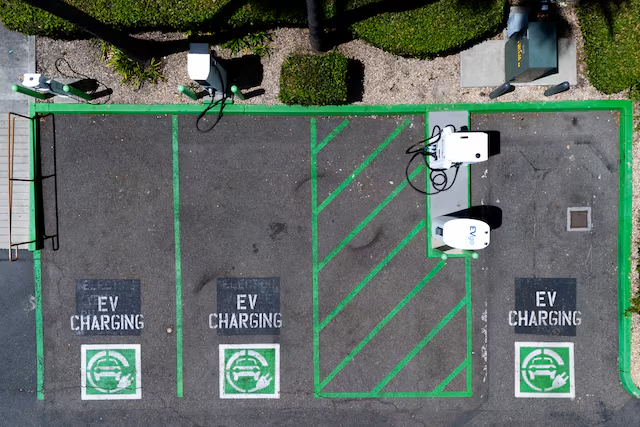
An electric vehicle charging location is shown from the view of a drone in Oceanside, California, U.S., May 14, 2025. REUTERS/Mike Blake Purchase Licensing Rights
The Trump California EV Battle is reshaping US auto policies, EV investments, and emissions rules.
Trump California EV Battle
The Trump California EV Battle has erupted into one of the most consequential regulatory conflicts in the modern auto industry. The legal clash between the administration of Donald Trump and the state of California over vehicle emissions rules could reshape electric vehicle (EV) adoption, disrupt automaker strategies, and redefine environmental policy in the United States.
For decades, California enjoyed unique authority to impose stricter vehicle emissions standards than federal rules through waivers granted by the Environmental Protection Agency. But that long-standing arrangement is now under threat, putting automakers — from EV leaders to traditional carmakers — in a difficult position.
Background of the Trump California EV Battle
The roots of the dispute lie in California’s authority to set independent emissions standards. Eleven other states follow California’s rules, representing nearly one-third of US vehicle sales.
Historically, Republican and Democratic administrations alike supported California’s waiver system. Under Joe Biden, federal policies aligned with California’s EV push. However, Trump’s second presidency marked a sharp reversal.
Why California’s Emissions Waiver Matters
California’s policy requires automakers to transition toward zero-emission vehicles, targeting 100% EV sales by 2035 with gradual milestones starting this decade.
This framework influences national automaker strategies because companies rarely design separate vehicles for different states. As a result, California’s standards often shape the entire US market.
Trump’s Anti-EV Policy Shift
Trump’s administration has dismantled several federal incentives supporting EV adoption, including:
- Ending the $7,500 federal EV tax credit
- Rolling back fuel-economy penalties
- Challenging climate findings used to justify emissions regulations
These moves aim to reduce regulatory pressure on fossil-fuel vehicle manufacturers but also risk slowing EV adoption nationwide.
Legal Fight Over the Congressional Review Act
The legal conflict intensified when congressional Republicans moved to cancel California’s waiver using the Congressional Review Act — a mechanism usually applied to federal regulations.
California argues that its waiver is not a regulatory “rule” but a case-specific approval, making its revocation unlawful. The dispute is now being heard in federal court in Oakland.
If California wins, automakers may need separate vehicle models to meet conflicting rules under Donald Trump policies. Industry groups warn higher costs and fewer choices could follow. Ongoing legal uncertainty is slowing EV investments, leaving manufacturers struggling to plan long-term strategies.
Impact on Tesla and EV Makers
The Trump California EV Battle has significant consequences for EV companies such as Tesla.
Key risks:
- Reduced demand for EV compliance credits
- Slower national EV adoption
- Investment uncertainty
Tesla historically earned billions by selling regulatory credits to other automakers. Weakening California’s standards could shrink this revenue stream.
Pressure on Traditional Automakers
Legacy automakers face the greatest operational complexity if California prevails.
Potential challenges:
- Designing separate vehicle lineups
- Increased production costs
- Regulatory uncertainty
Industry groups warn that conflicting policies could reduce consumer choice and complicate manufacturing planning.
Economic and Consumer Implications
The battle is already affecting industry investment. Analysts estimate automakers have written down tens of billions of dollars in EV spending amid policy uncertainty.
For consumers, the conflict could influence:
- Vehicle prices
- EV availability
- Fuel efficiency standards
- Charging infrastructure expansion
What Happens Next
The outcome of the federal court case will likely determine the future trajectory of US auto regulation.
Possible scenarios:
✔ California wins → Stronger EV mandates nationwide
✔ Trump administration wins → Slower EV transition and unified federal rules
✔ Compromise → Revised emissions standards balancing both approaches
Either way, the decision will shape automaker strategies for years to come.
Conclusion
The Trump California EV Battle highlights how political shifts can disrupt industry transformation. As federal and state policies diverge, automakers are caught navigating uncertain terrain while consumers face an evolving vehicle market.
The legal outcome will determine whether EV adoption accelerates or slows — but one thing is certain: this regulatory clash will shape the future of transportation in America.
Sources (DoFollow):
Read more on Reuters: https://www.reuters.com/legal/litigation/us-automakers-caught-crossfire-trump-california-ev-battle-2026-02-19/
More Information at Modern Diplomacy: https://moderndiplomacy.eu/2026/02/19/u-s-automakers-caught-in-the-middle-of-trump-california-ev-feud/