
Trump 15% Global Tariffs Spark Massive Market Shock
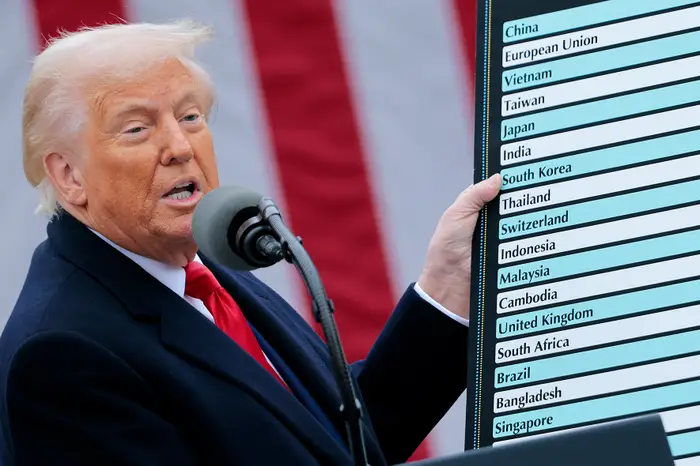
Donald Trump holds up a chart while speaking during a “Make America Wealthy Again” trade announcement event in the Rose Garden at the White House on April 2, 2025 in Washington, DC. Chip Somodevilla/Getty Images
Trump 15% Global Tariffs spark global trade tensions after a Supreme Court setback. Discover key impacts, reactions from allies, and what this dramatic tariff move means for the world economy.
Trump 15% Global Tariffs reshape global trade after court ruling
The Trump 15% Global Tariffs decision has triggered fresh economic uncertainty and diplomatic tension worldwide. Just one day after the Supreme Court of the United States blocked sweeping emergency tariffs, Donald Trump escalated trade measures by raising import duties to the maximum 15% allowed under Section 122 of the Trade Act of 1974.
The move marks a dramatic continuation of Trump’s aggressive trade agenda and signals that the tariff battle is far from over. Governments, businesses, and financial markets are now grappling with the implications of this temporary but powerful policy shift.
Supreme Court ruling and tariff escalation
The saga began when the Supreme Court struck down Trump’s previous tariffs imposed under emergency powers. In a 6–3 decision, the court ruled that the International Emergency Economic Powers Act did not grant authority to levy tariffs.
Chief Justice John Roberts wrote the majority opinion, stating the law was never intended for trade penalties. The ruling represented one of the most significant judicial setbacks for Trump’s economic strategy during his second presidency.
However, Trump responded swiftly by invoking Section 122, a rarely used provision allowing temporary tariffs of up to 15% for 150 days.
Legal basis for Trump 15% Global Tariffs
Section 122 explained
Section 122 of the Trade Act of 1974 allows a president to impose temporary tariffs to address balance-of-payments deficits. While the provision permits duties up to 15%, Congress must approve any extension beyond 150 days.
This authority has never been used for sweeping global tariffs, making Trump’s action legally and politically controversial.
Trump’s justification
Trump argued the tariffs were necessary to protect American industries and counter decades of unfair trade practices. Posting on Truth Social, he said countries had been “ripping off” the United States and the new tariff level was fully legal.
Political backlash in Washington
The tariff escalation sparked intense debate on Capitol Hill.
Democratic Congressman Ted Lieu criticized the move, arguing Trump was punishing Americans after losing in court. He predicted Democrats would challenge the tariffs legally and politically once the temporary window expires.
Meanwhile, some Republicans quietly welcomed the Supreme Court ruling, believing Trump’s earlier tariffs were hurting both the economy and their party politically.
Global reactions and diplomatic tensions
Europe’s warning
German Chancellor Friedrich Merz warned the tariffs could inject damaging uncertainty into global markets. He stressed that trade instability acts as “poison” for both European and American economies.
French President Emmanuel Macron emphasized the importance of checks and balances in democracies and called for reciprocal trade measures rather than unilateral actions.
UK and Canada responses
The United Kingdom expressed cautious optimism about maintaining its privileged trading relationship with Washington, while Canada welcomed the court ruling that had initially blocked Trump’s tariffs.
Economic impact on markets and industries
The Trump 15% Global Tariffs policy is expected to affect multiple sectors:
Rising consumer prices
Tariffs typically raise the cost of imported goods, potentially leading to higher prices for American consumers.
Supply chain disruption
Manufacturers relying on global supply chains may face increased costs and uncertainty.
Market volatility
Financial markets reacted cautiously as investors assessed the risk of renewed trade wars and retaliatory tariffs.
Despite concerns, the administration projected trillions of dollars in tariff revenue over the next decade. However, tariff collection data has not been released since December 2025, leaving analysts uncertain about actual gains.
Trade war risks and future outlook
Trump’s tariffs have long been central to his economic and foreign policy approach. By using trade penalties as leverage in negotiations, he has reshaped global trade dynamics and strained relationships with allies.
The latest escalation raises fears of retaliatory measures from trading partners, which could deepen economic fragmentation and slow global growth.
At the same time, Trump insisted existing trade deals negotiated under tariff pressure remain valid, including
What happens after 150 days
The temporary nature of Section 122 tariffs means the administration faces a deadline:
- Congress must approve any extension
- Legal challenges are likely
- New tariff authorities could be pursued
- Trade negotiations may intensify
This creates a high-stakes window in which economic diplomacy and domestic politics will determine the policy’s future.
Conclusion
The Trump 15% Global Tariffs decision marks a pivotal moment in international trade policy. While legally temporary, the tariffs carry significant economic and diplomatic consequences. With Congress, courts, and global partners now involved, the coming months will determine whether this escalation becomes a lasting shift or another chapter in an ongoing trade battle.
DoFollow resources:
For more CNN: https://edition.cnn.com/2026/02/21/politics/tariffs-ruling-supreme-court-trump-gop
Father more: The Guardians: https://www.theguardian.com/us-news/2026/feb/21/trump-tariffs-15-percent