Impressions from Mount Kenya, where fading glaciers are reshaping lives
Mountains cover more than a quarter of the Earth’s land surface. They carry deep spiritual significance, regulate weather and the water cycle, provide home to plants and animals, and, critically, hold about 70 percent of the world’s freshwater in their glaciers.
To highlight why mountains and glaciers need stronger protection, this year’s International Mountain Day on 11 December aligns with 2025’s International Year of Glaciers’ Preservation to spotlight montane glaciers and the vital water they provide to more than 2 billion people, in addition to supporting agriculture, energy, biodiversity and more.
Ahead of Mountain Day, UNEP’s Patron of the Oceans and endurance swimmer Lewis Pugh climbed Mount Kenya, which holds one of the last three glacier sites in Africa – and is expected to lose all of its ice within the next five years. Pugh also met communities at the mountain’s foothills to learn how the vanishing glaciers are reshaping their lives, livelihoods and cultural identities.
The shrinking glaciers of Mount Kenya are a clarion call to cut the drivers of glacier loss, to help communities adapt, and to mobilize greater finance for glacier-dependent regions across the globe.

More than two million people in Kenya and Tanzania depend on water from Mount Kilimanjaro and Mount Kenya (pictured above), which, together with the Rwenzori Mountains, hold the last glaciers in Africa. The glaciers on Mount Kenya are almost all gone, having lost more than half their area since 2016 alone. Standing on the frontlines of climate change, Mount Kenya is poised to lose these ancient ice caps – which have crowned the mountain since the last ice age – by 2030.

Near the base of Mount Kenya in a village called Naibor, the Yiaku people have been forced to adapt to new realities of drier rivers and changing weather patterns. Here, Josephine Kasoo shares how her community has used a small pilot grant from UNEP’s Mountains ADAPT Small Grants programme to diversify their crops with corn, spinach, aloe vera, dragon fruits and sukuma – a hearty leafy green – in order to make their food production more resilient and attuned to drier landscapes.

The village elders described how, in the 1960s and ‘70s, the top of Mount Kenya was covered in snow and ice. In the 1990s, the ice began to recede, and rivers began to flow less predictably. Now, the snow and ice is almost gone, and the lack of water poses increasing challenges. With the mountain’s significance deeply engrained in local culture – its white peaks believed to be the home of gods – the irreversibility of the loss is difficult to comprehend. “When will the glaciers come back?” asked Risper Ogusini.

Even the seasons they have shifted,” said Jennifer Koinante, Executive Director of the Yiaku Laikipiak Trust, which distributed the Mountains ADAPT small grant to the Naibor community. “The pastoralists have to take their cows and livestock through the town up the mountain to find water because the rivers here, they have dried.

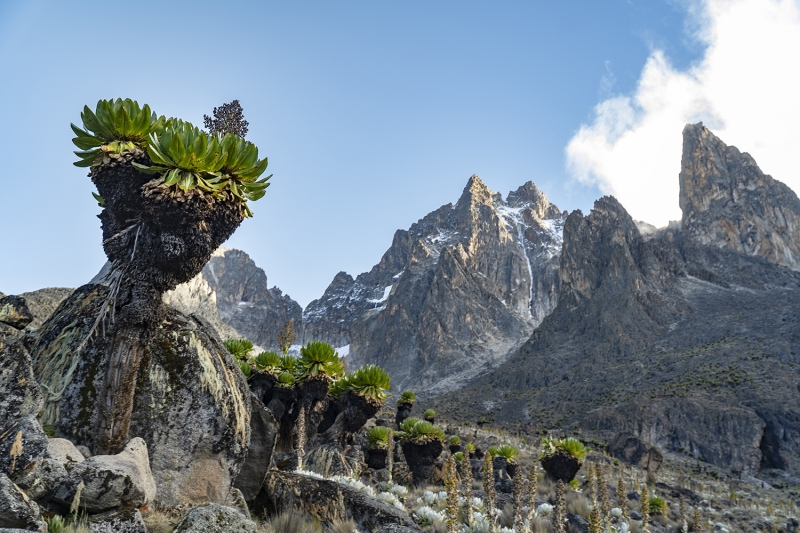
On the mountain, distinct vegetation zones range from the lower, more tropical montane forests to the upper Afro-alpine’s rocky outcrops. Rare mammals make their home here, including bongos, leopards and hyraxes, while endemic fauna include giant groundsels and lobelias, pictured here.

The lower parts of the mountain are grounds for peatlands – wetlands formed from decomposed plant material that are some of the world’s richest carbon sinks, found on every continent. In mountain ecosystems, peatlands also play a key role in the hydrological cycle. They act like sponges, storing water and slowly releasing it, while filtering, purifying, and regulating river flows from water that comes down from the glaciers.
Source: UNEP