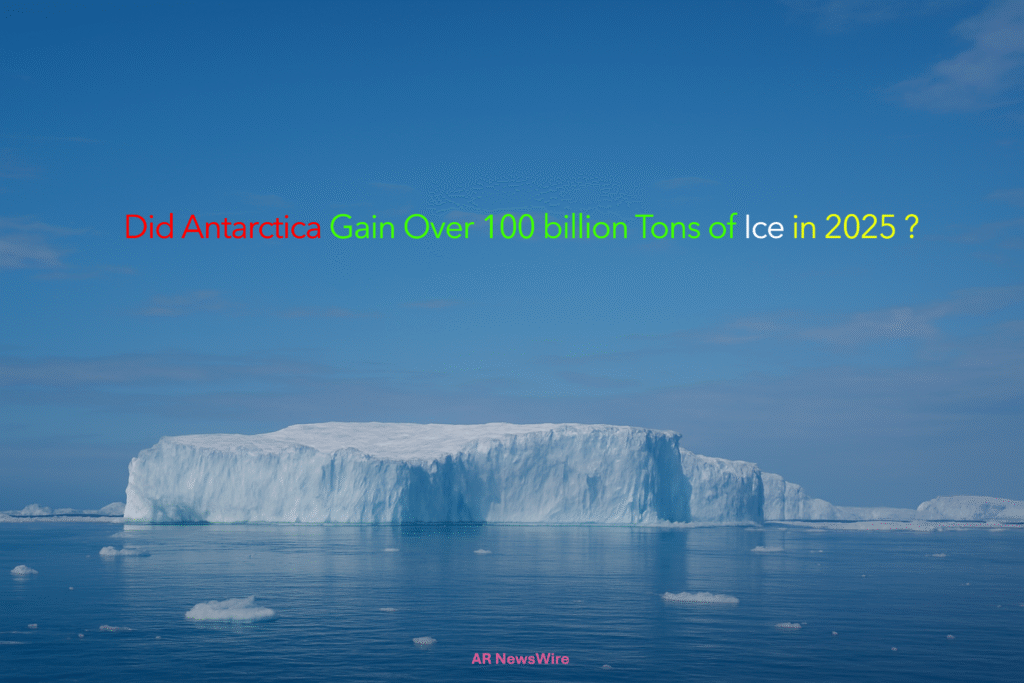
Did Antarctica Gain Over 100 billion Tons of Ice in 2025? The Facts Behind the Claim
A flurry of headlines and social media posts in 2025 proclaimed a remarkable turnaround in Antarctica: the massive ice sheet at the bottom of the world has started growing again. Some even went so far as to claim this signals the end of global warming or that climate change is a hoax. But a deeper look at the science and how the data are being used shows that this interpretation is misleading. (DW)
A Surprising Study Finds Short-Term Ice Gain
In May 2025, a study reported that the Antarctic Ice Sheet — the vast mass of frozen land ice surrounding the South Pole — gained mass between 2021 and 2023. Satellite data showed that four major glacier basins in East Antarctica experienced significant growth, largely due to unusually heavy snowfall during that period. This was the first time in decades that scientists observed such a rebound, briefly slowing the rise of global sea levels. (LiveNOW)
That finding was striking enough to turn heads — and fuel social media claims that climate change might be reversing. (DW)
Why Quick Conclusions Are Misleading
However, fact-checkers cautioned that this short-term increase does not mean the climate crisis is over. The researchers themselves and climate scientists emphasize that the Antarctic ice system naturally fluctuates from year to year. Focusing on just a couple of years — in this case, 2021–2023 — can give a distorted picture of long-term trends. (DW)
Climate experts normally analyze decades of data to understand meaningful changes. A brief period of increased snowfall or mass gain can occur even while long-term warming continues. (DW)
The Danger of Cherry-Picked Comparisons
Another misleading claim involved comparing sea ice extent on specific calendar dates decades apart to suggest that Antarctic ice is growing overall. In February 2025, Reuters fact-checked such posts that contrasted sea ice extent on December 24, 1979, with the same date in 2024. The result showed a higher figure in 2024 — but only for those specific days. (Reuters)
Experts told Reuters that cherry-picking isolated dates ignores the fact that Antarctic sea ice fluctuates enormously throughout the year. Long-term data show that Antarctic sea ice increased slightly from 1979 until around 2015 and has since experienced a sharp decline — a pattern influenced by complex interactions of winds, ocean currents and natural variability.
Importantly, these short-term snapshots cannot be used to prove that human-driven climate change is not occurring. Climate scientists note that other evidence — such as Arctic sea ice loss, rising global temperatures and warming oceans — continues to show a warming planet. (Reuters)
What the Science Really Shows
So, what’s really going on in Antarctica?
- A recent study observed a temporary mass gain in parts of East Antarctica from 2021 to 2023 due to increased snowfall. (LiveNOW)
- Short-term data like this can be misleading if taken out of context — long-term trends are what matter. (DW)
- Comparisons of sea ice on specific dates can be cherry-picked and do not represent the long-term behavior of the ice. (Reuters)
In other words: while parts of Antarctica may show temporary gains or variability in ice measurements, these data points do not overturn decades of evidence that the Earth’s climate is warming. Careful scientific analysis over long time scales remains essential for understanding climate change — and quick conclusions based on short-term data can be misleading at best. (DW)