Why Al Governance Tools Are Now Essential for Enterprise Data Success
Introduction: What Data-Related Issues Do Contemporary Organizations Face?
Today’s businesses rely on data for daily operations, supply chain visibility, customer experience, compliance, and strategic decision-making. Even with contemporary technologies in place, the majority of businesses still face a crucial problem: making sure their data is correct, controlled, and usable.
Discussions around enterprise data management technologies and AI governance have therefore accelerated. Data-storing tools are no longer necessary for businesses. They require sophisticated systems capable of interpreting data, controlling it, continuously monitoring it, and building trust on a large scale.
To put it simply, this change represents a total rethinking of how the business functions and develops going forward rather than only a technological improvement.
Why Are AI Governance Tools More Important Than Before?
In a world where manual governance is unable to keep up, AI governance tools assist businesses in maintaining trusted, consistent, and reliable data.
Traditional governance techniques, such as manual reviews, spreadsheets, and human-dependent checks, are unable to handle the complexity of growing data volumes across systems, geographies, and teams. Decision-making is weakened by the proliferation of errors, the spread of duplication, and contradictory definitions.
How the Game Is Changed by AI Governance Tools
- Real-time data scanning
- Identify dangers and irregularities
- Fix mistakes and irregularities
- Automatically strengthen governance
The Principal Results of the Top AI Governance Tools for Business Data Administration
1. Reliable information prior to entering business processes
2. Uniformity among departments, regions, and platforms
3. Using trustworthy and verified information to make better decisions
True enterprise transformation begins with this transition from reactive to ongoing, intelligent governance.
What Role Does PiLog Play in AI Governance?
PiLog combines deep interaction with enterprise systems, AI capabilities, ISO-certified governance, and worldwide experience.
PiLog has been a leader in data governance for more than 20 years, and its established ecosystem, reliable techniques, and demonstrated industry outcomes set it apart.
1. Compliance with ISO Standards
PiLog employs globally accepted, ISO-certified techniques to assist businesses in adhering to international governance norms. This leads to:
- Easy audits
- trustworthy quality assurance
- Simplified evaluations of compliance
All of this takes place without requiring additional operational work.
2. Foundry for iContent
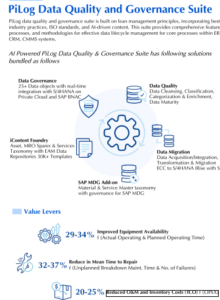
With more than 25 million templates, taxonomies, and classification structures, it is one of the biggest content stores in the world. It permits:
- Rapid standardization
- Materials, assets, product/service data, and customer data harmonization
- Data models that are consistent across international organizations
3. AI Perspective
The exclusive AI Lens from PiLog instantly recognizes:
- Duplicates
- Unusual
- Inaccurate entries
- Absence of characteristics
- Format problems
- Disparities
In addition to recognizing problems, it avoids operational effect by finding early solutions.
4. SAP Premium Partner + SAP Store Certified PiLog easily integrates with important SAP ecosystems, including:
- SAP ECC S/4HANA
- SAP MDG Ariba Success Factors
Stability and compatibility in business settings are guaranteed by SAP Store accreditation.
5. International Honors & Recognition
PiLog’s governance platforms are known throughout the world for producing reliable, quantifiable, and consistent business results. PiLog consistently rates among the top options for businesses assessing the finest AI governance solutions for enterprise data management.