Shocking 5 Iranian Women Footballers Seek Asylum in Australia After Anthem Protest
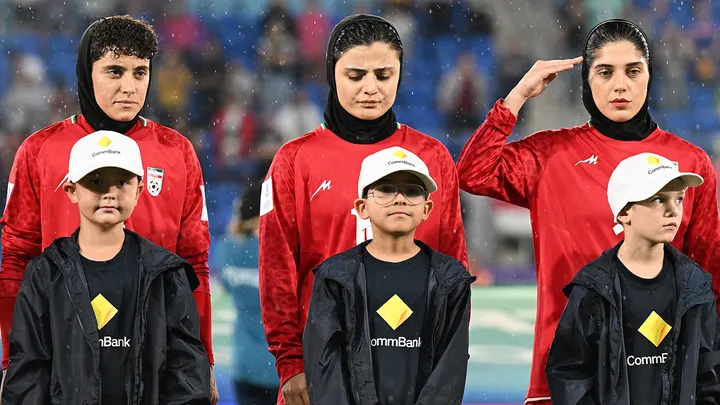
Iran players react during their national anthem ahead of the Women's Asian Cup soccer match between Iran and the Philippines in Robina, Australia, Sunday, March 8, 2026. (Dave Hunt/AAP Image via AP)
Five Iranian women footballers seek asylum Australia request sparks global concern after the team’s anthem protest during the Women’s Asian Cup. Activists and football unions urge protection for players fearing persecution if they return to Iran.
5 Iranian Women Footballers Seek Asylum in Australia After Anthem Protest
Iranian women footballers asylum Australia has become a global headline after five members of Iran’s national women’s football team reportedly sought protection in Australia during the AFC Women’s Asian Cup 2026. The players’ decision came amid fears of retaliation from authorities after they refused to sing the national anthem before a tournament match.
The situation has sparked international debate about athlete safety, political pressure, and human rights, with football unions and activists urging the Australian government to protect the players.
Background of the Iranian Women’s Football Team Crisis
The Iranian women footballers seek asylum in Australia issue began during the 2026 AFC Women’s Asian Cup held in Australia. The Iranian national team traveled to compete in the regional tournament but quickly found themselves at the center of political controversy.
Reports indicate that several players left the team hotel during the tournament. According to sources close to the situation, five Iranian women footballers have already applied for asylum in Australia and are currently under protection.
At least two additional players who reportedly left the hotel remain unaccounted for.
Why the Players Are Seeking Asylum
The Iranian women footballers asylum Australia case is largely driven by fears of punishment if the players return home.
Iran has a history of strict political oversight of athletes, particularly when actions are seen as criticism of the government. Activists claim that refusing to sing the national anthem can be interpreted as political defiance.
Sports journalist Raha Pourbakhsh reported that families of several players were allegedly threatened after the anthem protest.
Human rights groups warn that the players could face severe consequences upon returning to Iran.
Anthem Protest That Sparked Global Attention
The controversy started when the Iranian team remained silent during their national anthem before a group stage match.
The symbolic act was widely interpreted as a protest linked to political tensions and human rights issues in Iran.
In recent years, Iranian athletes across various sports have used similar gestures to express solidarity with protests and social movements in the country.
The anthem protest quickly turned the Iranian women footballers asylum seek in Australia story into an international headline.
Trump’s Warning to Australia
Former U.S. President Donald Trump also weighed in on the controversy.
Posting on his social media platform, he warned that forcing the players to return to Iran could be dangerous.
Trump wrote:
“Australia is making a terrible humanitarian mistake by allowing the Iran National Women’s Soccer team to be forced back to Iran.”
He even suggested the United States could offer asylum if Australia refused.
His statement further amplified global attention on the Iranian women footballers asylum Australia situation.
Concerns From Football Unions and Activists
The global footballers’ union FIFPRO has expressed serious concern for the players’ safety.
Beau Busch, FIFPRO’s president for Asia and Oceania, said the organization has struggled to communicate directly with the team.
According to Busch, the players may face persecution after being labeled “wartime traitors.”
The union is now working with:
- FIFA
- Asian Football Confederation
- Australian authorities
to ensure the players are protected.
Iranian Federation and Government Response
The president of the Iranian Football Federation, Mehdi Taj, reportedly had his visa denied when attempting to travel to Australia to retrieve the team.
Instead, federation vice president Farideh Shojaei traveled in his place.
Meanwhile, Australian officials have declined to comment on the asylum applications due to privacy laws.
Matt Thistlethwaite stated that the government cannot discuss individual immigration cases.
What Could Happen Next
The Iranian women footballers seek asylum in Australia case could lead to several possible outcomes:
1. Asylum Approval
Australia may grant refugee status if authorities determine the players face credible threats.
2. Temporary Protection
The players could be given temporary humanitarian visas while their cases are reviewed.
3. Diplomatic Negotiations
International organizations may intervene to ensure safe passage or protection.
4. Global Sports Sanctions
If the players face punishment, pressure could increase on Iran’s sports authorities.
Global Reaction and Human Rights Concerns
Human rights activists say the case highlights the risks athletes face when politics intersects with sports.
The situation is particularly sensitive because Iran is currently experiencing heightened geopolitical tensions and internal political pressure.
Advocacy groups argue that the players should be given protection until their safety can be guaranteed.
For many observers, the Iranian women footballers seek asylum in Australia case is no longer just a sports story—it has become a broader test of international humanitarian principles.
(DoFollow) Resources:
Read more on Al Jazeera: https://www.aljazeera.com/sports/2026/3/9/fear-uncertainty-surround-iran-womens-football-teams-return-home
Read full article at CNN: https://edition.cnn.com/2026/03/09/sport/australia-iran-women-soccer-asian-cup-intl-hnk
Further more over FOX News: https://www.foxnews.com/sports/trump-warns-australia-is-making-terrible-humanitarian-mistake-over-iranian-womens-soccer-team